
Table of Contents
EV Charging for Schools: Complete Guide to Campus Electrification & Grants
Across North America and globally, educational institutions—from K-12 school districts to community colleges and universities—are experiencing an unprecedented transformation in campus transportation. Driven by landmark environmental mandates, federal funding initiatives like the US EPA Clean School Bus Program, and rising fuel costs, electric vehicle (EV) charging for schools has transitioned from a progressive pilot concept to an essential operational strategy.
School campuses occupy a unique double position in the clean energy ecosystem: they manage massive yellow bus fleets that serve millions of children daily while simultaneously acting as high-density parking hubs for teachers, administrative staff, parents, and community members. By deploying smart, scalable EV charging infrastructure, schools lower operational expenditures, clean up local air quality, generate auxiliary revenue, and teach future generations about sustainable technology.
This definitive guide breaks down everything school board members, superintendents, facility directors, and fleet managers need to know about planning, funding, installing, and managing EV charging infrastructure tailored specifically for educational environments.
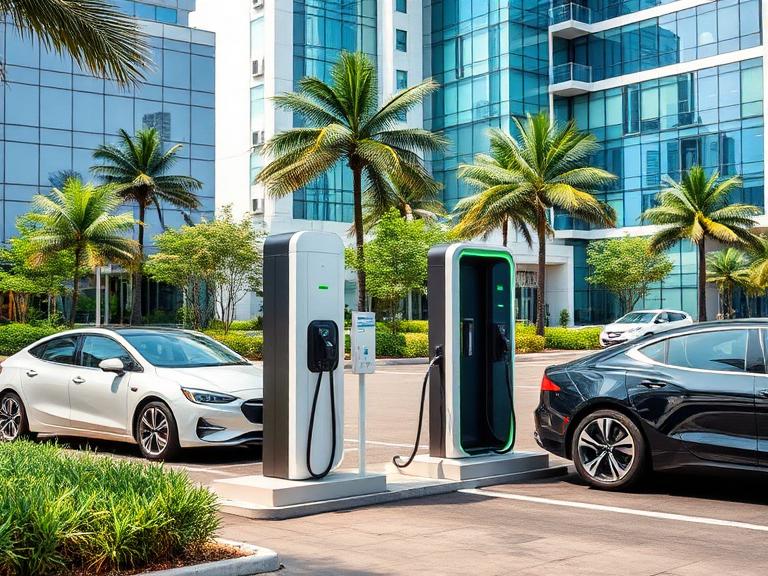
Why Schools Must Prioritize EV Charging Infrastructure Now
The shift toward campus electrification delivers measurable benefits across financial, health, environmental, and educational domains.
1. Massive Fleet Operational Cost Savings
School buses represent the single largest public transit system in many countries. Traditional diesel buses consume vast amounts of fuel and require frequent engine maintenance, oil changes, transmission overhauls, and exhaust system repairs.
- Fuel Savings: Electricity is significantly cheaper and less volatile than diesel fuel on a cost-per-mile basis. School districts typically save between $4,000 and $11,000 per bus per year in energy costs alone.
- Maintenance Savings: Electric buses and staff EVs have significantly fewer moving parts—no spark plugs, mufflers, diesel particulate filters (DPFs), or complex multi-speed transmissions. Regenerative braking also drastically reduces brake pad wear, yielding an additional 40% to 50% reduction in long-term maintenance costs.
2. Protecting Student & Community Health
Children are uniquely vulnerable to air pollution. Legacy diesel school buses emit toxic exhaust gases, including particulate matter ($PM_{2.5}$) and nitrogen oxides ($NO_x$), which concentrate around school loading zones and leak into bus cabins during transit.
- Asthma and Respiratory Health: Diesel exhaust exposure is directly linked to increased rates of pediatric asthma, missing school days, and reduced cognitive health.
- Zero Tailpipe Emissions: Replacing diesel fleets with electric school buses paired with dedicated campus charging infrastructure completely eliminates toxic tailpipe emissions in bus drop-off lanes and neighborhood routes.
3. Federal & State Funding Is at an All-Time High
Educational institutions currently have access to unprecedented levels of government funding designed to cover the high upfront costs of EV charging infrastructure:
- EPA Clean School Bus Program: A multi-billion dollar initiative providing grants and rebates covering up to 100% of the cost for electric school buses plus their associated charging infrastructure for high-need, rural, and tribal school districts.
- Inflation Reduction Act (IRA) Section 30C: Offers tax credits and direct-pay incentives (Alternative Fuel Vehicle Refueling Property Credit) that offset up to 30% of EV charger installation costs for non-taxable public entities like school districts.
- Utility Make-Ready Programs: Electric utility companies frequently cover 50% to 100% of the customer-side electrical infrastructure upgrades (transformers, conduit, trenching, service panels) required to power school charging depots.
4. Faculty Recruitment, Retention, & Workplace Perks
School districts constantly seek competitive advantages to attract and retain talented teachers and administrative staff. Providing reliable, affordable Level 2 EV charging in teacher parking lots is a highly visible workplace benefit.
5. Curriculum Integration & STEM Learning
Modern smart EV charging platforms collect rich, real-time datasets including kilowatt-hour ($kWh$) usage, carbon offsets, solar energy integration, and battery state-of-charge curves. Math and science educators can turn school chargers into living laboratories for STEM projects on energy efficiency, electrical physics, and climate science.
The Three Core Use-Cases for Campus EV Charging
Understanding who will use your EV chargers determines the hardware, software, power requirements, and location of your installation. Most educational institutions deploy chargers across three distinct zones:
                  ┌─────────────────────────────────────────┐
                  │       School EV Charging Ecosystem     │
                  └────────────────────┬────────────────────┘
                                       │
        ┌──────────────────────────────┼──────────────────────────────┐
        ▼                              ▼                              ▼
┌───────────────┐              ┌───────────────┐              ┌───────────────┐
│ Bus Fleet Depot│              │ Staff & Faculty│              │ Public & Visitor│
│ (Heavy Duty)  │              │ (Workplace)   │              │ (Community Hub)│
└───────┬───────┘              └───────┬───────┘              └───────┬───────┘
        │                              │                              │
  • Over-night L2                • Dual-port L2                 • Smart Networked
  • High-power DCFC              • RFID Access Control          • Mobile App Payments
  • Managed Scheduling           • Employee Discounts           • Public Weekend Access
Zone 1: Fleet Depot Charging (Electric School Buses & District Vehicles)
- Primary Vehicles: Type A, C, and D Electric School Buses, maintenance vans, district groundskeeping trucks, and security patrols.
- Hardware Requirements: High-output Level 2 AC chargers (19.2 kW) for overnight dwell times (8-10 hours) or 60 kW – 180 kW DC Fast Chargers (DCFC) for fast mid-day turnarounds between morning drop-off and afternoon pick-up runs.
- Location: Secure, fenced district bus yards or fleet maintenance facilities with restricted access.
Zone 2: Staff & Faculty Workplace Charging
- Primary Vehicles: Personal passenger electric vehicles driven by teachers, principals, custodians, and administrative staff.
- Hardware Requirements: Standard Level 2 dual-port commercial chargers (7.2 kW to 11.5 kW per port). These allow teachers to plug in upon arriving at 7:30 AM and receive a full charge before school adjourns.
- Location: Staff-designated parking lots equipped with RFID card access or private mobile app authentication.
Zone 3: Visitor, Event, & Community Public Charging
- Primary Vehicles: Parents picking up students, visiting athletic teams, evening event attendees, and local community members during non-school hours.
- Hardware Requirements: Networked Level 2 chargers or entry-level DC Fast Chargers equipped with credit card readers and dynamic pricing capabilities.
- Location: Front visitor parking lots, athletic stadium parking, or community auditorium parking areas easily accessible from main roads.
Technical Comparison: Level 2 vs. DC Fast Charging for Educational Campuses
Selecting the right balance between Level 2 and DC Fast Charging hardware depends directly on your fleet’s schedule, available electrical panel capacity, and budget.
| Feature / Metric | Level 2 AC Commercial Charging | DC Fast Charging (DCFC) |
| Voltage Input | 208V / 240V AC (Single or 3-Phase) | 480V 3-Phase AC |
| Power Output Range | 7.2 kW – 19.2 kW | 50 kW – 350 kW |
| Charging Speed (Passenger EV) | 25 – 40 miles of range per hour | 100 – 250+ miles of range in 30 mins |
| Charging Speed (School Bus) | 8 – 11 hours (Full Charge) | 1.5 – 3 hours (Full Charge) |
| Best Used For | Overnight bus parking & staff daytime parking | Mid-day bus route top-offs & public hubs |
| Hardware Cost (per unit) | $2,500 – $8,000 | $30,000 – $120,000+ |
| Installation & Trenching | Moderate ($2,000 – $7,000/port) | High ($15,000 – $60,000+/port) |
| Grid Capacity Required | Standard electrical panel capacity | May require dedicated transformer upgrade |
Funding & Financial Strategies for School Districts
Funding is often perceived as the single biggest hurdle for school EV projects. However, combining multiple federal, state, utility, and private funding streams allows many school districts to achieve near-zero out-of-pocket costs.
1. EPA Clean School Bus (CSB) Program
Created under the Bipartisan Infrastructure Law, this program allocates $5 Billion over 5 years specifically for school bus fleet replacement and infrastructure.
- Bus Subsidies: Up to $375,000 per electric bus for high-need school districts.
- Infrastructure Subsidies: Up to $20,000 per bus in dedicated charging infrastructure funding.
- Priority Status: Rural districts, low-income communities, and Bureau of Indian Affairs schools receive top funding priority and maximum award amounts.
2. IRA Direct Pay Tax Credits (Section 30C)
Under the Inflation Reduction Act, tax-exempt entities like public schools and municipalities can receive direct cash payments (termed “Elective Pay” or “Direct Pay”) equal to 30% of the total installation cost of qualified EV charging infrastructure located in low-income or non-urban census tracts.
3. Utility “Make-Ready” Rebates
Electric utilities nationwide offer specialized commercial electrification programs. Under a “Make-Ready” model:
- The utility company pays for, installs, and maintains all the heavy electrical infrastructure up to the charger (including meters, conduits, panels, transformers, and trenching).
- The school district only pays for the charger hardware itself, which is often offset by additional hardware grants.
4. Vehicle-to-Grid (V2G) Revenue Models
Electric school buses possess massive battery packs (typically 150 kWh to 300+ kWh). Because school buses sit idle during peak summer electricity demand periods, school districts can utilize Vehicle-to-Grid (V2G) technology.
During high-demand summer heatwaves, the utility company draws stored clean energy from parked school buses back into the electric grid. The utility then pays the school district wholesale power rates or capacity payments, converting parked buses into revenue-generating energy storage assets.
Step-by-Step Implementation Framework for School EV Charging
Implementing an EV charging project requires coordination between school boards, facilities staff, electrical contractors, utilities, and software providers.
1.Fleet & Parking Needs Assessment:Duration: Weeks 1–3.
Gather baseline data on district transportation routes, daily vehicle mileage, teacher parking demand, and available physical parking spaces. Determine how many Level 2 vs. DC Fast Charging ports are required for short-term and 10-year growth plans.
2.Utility Engagement & Load Study:Duration: Weeks 4–7.
Meet with your local electric utility provider to perform a site load capacity analysis. Identify existing electrical service capacity at your bus depot or main building, locate nearest transformers, and evaluate potential utility Make-Ready rebate programs.
3.Grant Application & Financial Stacking:Duration: Weeks 8–12.
Apply for federal grants (EPA Clean School Bus Program), state clean transportation funds, and IRA Direct Pay credits. Combine these incentives to build a multi-layered funding model that minimizes out-of-pocket capital expenditures.
4.RFP Issuance & Hardware/Software Selection:Duration: Weeks 13–16.
Issue a Request for Proposal (RFP) for turnkey EV charging solution providers. Prioritize chargers that support Open Charge Point Protocol (OCPP), UL safety certifications, smart load management, robust cable retractors, and V2G readiness.
5.Civil Engineering & Installation:Duration: Weeks 17–24.
Complete site engineering, concrete trenching, conduit laying, sub-panel upgrades, and bollard installation. Mount the chargers, run heavy-duty cabling, and install ADA-compliant signage and pavement markings.
6.Commissioning, Networking, & Staff Training:Duration: Weeks 25–26.
Activate cellular/Wi-Fi communication modules, register hardware on the cloud management platform, configure access control (RFID cards/apps), set dynamic pricing schedules, and train facility managers and bus drivers.
Safety, Access Control, and Physical Security Standards
Educational facilities must enforce strict safety and access standards to protect students, staff, and district property.
+-----------------------------------------------------------------------+
|                    SCHOOL CAMPUS EV SAFETY CHECKLIST                  |
+-----------------------------------------------------------------------+
|  [✓] Physical Protection: Industrial concrete-filled steel bollards   |
|  [✓] Trip Mitigation: Overhead cable suspension / retractor systems   |
|  [✓] Access Control: Restricted RFID / app authentication during school|
|  [✓] Lighting & Surveillance: 24/7 LED illumination & CCTV coverage   |
|  [✓] Emergency Protocols: Integrated emergency shut-off switches      |
|  [✓] Weatherproofing: Minimum NEMA 3R / NEMA 4 rated enclosures       |
|  [✓] Accessibility: Compliant ADA parking spaces and reach heights    |
+-----------------------------------------------------------------------+
1. Cable Management & Trip Prevention
Heavy-duty Level 2 and DC Fast Charging cables can create serious trip hazards in busy school parking lots and bus depots. Chargers installed at schools should feature overhead counterbalanced cable retractors that automatically pull cables up and out of walkways when not in active use.
2. Physical Protection (Bollards & Enclosures)
Chargers placed in bus yards or high-traffic student drop-off zones must be protected against accidental vehicle impacts. Heavy-duty steel bollards filled with concrete should surround all pedestal units. Hardware should carry a minimum NEMA 3R or NEMA 4 rating to resist extreme rain, ice, dust, and vandalism.
3. Smart Access Control & Security
Schools cannot afford unmonitored power consumption or unauthorized vehicles blocking fleet charging bays.
- School Hours (7 AM – 4 PM): Chargers can be restricted solely to authorized district RFID cards (issued to bus drivers and teachers) or approved accounts within a private mobile app.
- After Hours & Weekends: Smart cloud software automatically opens designated chargers to the general public, accepting credit card payments through mobile apps and generating municipal revenue.
4. Smart Load Management (Avoiding Electrical Overloads)
Instead of spending hundreds of thousands of dollars to upgrade main electrical transformers, schools can use Smart Load Management (SLM) software. SLM dynamically balances available electrical capacity across multiple chargers in real time.
Example: If ten electric buses are plugged in simultaneously, SLM distributes power evenly across all ten units overnight. If one bus needs to leave early, the software automatically routes higher power to that specific port without exceeding the campus electrical panel’s safety limit.
Frequently Asked Questions (15 Key FAQs)
FAQ 1: Why should schools invest in electric vehicle (EV) charging stations?
Schools benefit from EV charging by supporting fleet electrification (such as electric school buses), providing valuable staff and teacher perks, generating auxiliary revenue, meeting municipal sustainability targets, eliminating toxic emissions near student areas, and serving as real-world educational tools for STEM programs.
FAQ 2: What charger types are best suited for school campuses?
Level 2 (208/240V, 7.2 kW to 19.2 kW) chargers are ideal for staff and faculty parking during school hours and overnight school bus charging. DC Fast Chargers (50kW to 180kW+) are recommended for mid-day bus top-offs between morning and afternoon routes, high-throughput fleet operations, or public charging hubs during non-school hours.
FAQ 3: How much does it cost to install EV charging stations at a school?
Level 2 dual-port commercial chargers generally cost between $3,000 and $10,000 per unit, plus $2,000 to $10,000 per port in trenching and electrical infrastructure upgrades. DC Fast Chargers range from $30,000 to over $100,000 per charger depending on power capacity. However, federal, state, and utility grants frequently cover 80% to 100% of total project costs.
FAQ 4: What grants and incentives are available for school EV charging?
Major funding streams include the EPA Clean School Bus Program (offering billions in grants for buses and charging infrastructure), the Inflation Reduction Act (IRA) Section 30C Direct Pay credits, state-level climate grants (e.g., CARB in California, NYSERDA in New York), and utility-sponsored Make-Ready rebate programs.
FAQ 5: How long does it take to charge an electric school bus?
Using a high-output Level 2 (19.2 kW) AC charger, an electric school bus with a 220 kWh battery takes roughly 8 to 11 hours for a full charge—perfect for overnight dwell times. With a 60 kW to 120 kW DC Fast Charger, charging takes between 1.5 to 3 hours, making it ideal for quick mid-day route turnarounds.
FAQ 6: What is Vehicle-to-Grid (V2G) technology, and how does it benefit school districts?
V2G allows electric school bus batteries to discharge stored energy back into the electrical grid or campus buildings during peak demand hours or summer months when buses sit idle. Utilities pay school districts for this energy, creating a lucrative revenue stream that offsets operational costs and stabilizes the local power grid.
FAQ 7: How can school districts prevent unauthorized public access to chargers during school hours?
Smart networked EV chargers allow administrators to restrict access via RFID cards, mobile apps, or PIN codes. Schools can schedule chargers to be private during school hours for staff/buses, and automatically open them for paid public access during evenings, weekends, and summer breaks.
FAQ 8: Will installing EV chargers overload our school’s existing electrical service?
Not necessarily. An initial electrical load capacity assessment determines existing headroom. Smart Load Management software dynamically balances power distribution across multiple chargers in real time, preventing demand spikes and avoiding expensive utility transformer upgrades.
FAQ 9: Who pays for the electricity used by school EV chargers?
Schools can choose their monetization model. Options include free charging for faculty as a workplace benefit, cost-recovery pricing for teachers and visitors, market-rate pricing for the general public, or fully subsidized charging through grant funding and solar offsets.
FAQ 10: Are there specific safety standards required for school EV charging stations?
Yes. Chargers must be UL-listed (e.g., UL 2594, UL 2202), compliant with NEMA 3R/4 weatherproof standards, ADA compliant, equipped with cable management retractors to eliminate trip hazards, and protected by concrete bollards.
FAQ 11: How do schools handle EV charging maintenance and repairs?
Most commercial EV charging vendors offer turnkey Operations & Maintenance (O&M) service level agreements (SLAs). These cover remote network diagnostics, cellular connectivity, hardware repairs, vandal damage protection, and routine preventive maintenance.
FAQ 12: Can rural school districts benefit from EV charging and electric buses?
Yes. Modern electric school buses have ranges between 100 to 210 miles per charge, which comfortably covers most rural routes. Federal programs like the EPA Clean School Bus program explicitly prioritize rural and high-need school districts for 100% grant funding.
FAQ 13: What is the difference between networked and non-networked chargers for schools?
Non-networked chargers are simple plug-and-play devices with no software control. Networked chargers connect via Wi-Fi/cellular to cloud platforms, enabling remote monitoring, access scheduling, user billing, load management, and federal grant compliance reporting.
FAQ 14: How do EV charging stations support school STEM education?
Interactive EV charging dashboards provide real-time data on energy consumption, solar panel integration, carbon offset metrics, and battery physics. Teachers can integrate this data directly into physics, chemistry, mathematics, and environmental science curricula.
FAQ 15: What is the typical timeline for an EV charging project at a school?
A standard school EV charging project takes between 3 to 9 months. This includes site assessment and engineering (1-2 months), utility interconnections and permitting (1-3 months), equipment procurement (1-2 months), and installation with commissioning (2-4 weeks).


Leave a Comment
You must be logged in to post a comment.