Table of Contents
5 Minute Desk Yoga for Office Workers | Quick Posture Fixes
Implementing a routine focused on 5 minute desk yoga for office workers is a highly effective, scientifically validated way to combat the negative effects of sitting all day. By dedicating just 300 seconds to intentional, breath-synchronized stretching, professionals can quickly undo spinal compression, reduce muscle strain in the neck and shoulders, and increase blood flow to stagnant muscle tissue. This quick corporate wellness routine doesn’t require yoga mats or changes of clothing. It can be practiced discreetly right in an office chair to lower cortisol levels and boost energy.
For professionals located across busy urban hubs like Chennai, balancing work deadlines with regular movement breaks is key. Incorporating custom micro-mobility programs—like those offered online or through corporate sessions at local centers like 136.1 Yoga Academy—helps maintain spinal health and prevent repetitive strain injuries.
The Hidden Costs of Sedentary Desks: The Biomechanics of Office Fatigue
Sitting for hours at a desk is more than an inconvenience; it actively alters the structural health of the human musculoskeletal system. When an office worker sits in a standard chair facing a computer monitor for eight to ten hours, the body goes into a low-energy state that slows down natural metabolic functions. It also places a heavy structural load on the lumbar and thoracic spine.
Without intentional movement, the human body adapts to the shapes it holds most often. In a corporate environment, this means the body conforms to the shape of an office chair.
[Sedentary Work Sitting] ────► Hip flexors stay shortened and tight
                                              │
                                              ▼
[Pelvic Misalignment] ───────► Anterior tilt pulls low back into strain
                                              │
                                              ▼
[Thoracic Compensation] ─────► Ribcage slumps forward, collapsing lungs
                                              │
                                              ▼
[Systemic Fatigue] ──────────► Restricted breath patterns, low brain oxygenation
This structural breakdown begins at the hips. When sitting, the hip flexors (specifically the psoas major and iliacus muscles) remain in a constantly shortened position. Over months and years, these tissues shorten and tighten permanently. When an office worker stands up, these tight hip flexors pull down on the pelvis, creating an anterior pelvic tilt. This tilt forces the lower back into a deep, painful arch, compressing the lumbar discs and causing chronic lower back pain.
Further up the spine, the ribcage typically slumps down toward the lap, causing a rounded upper back (thoracic kyphosis). This slouching posture closes off the chest cavity, compressing the lungs and preventing the diaphragm from expanding fully. Consequently, office workers tend to breathe shallowly using only their upper chest muscles. This shallow breathing limits oxygen intake and leaves the body in a state of low-grade fight-or-flight, which drains daily energy and focus.
Why 5-Minute Micro-Breaks Work: The Science of Movement
Many professionals think that a grueling one-hour workout at the gym after work can completely undo the damage of sitting at a desk all day. However, sports medicine research shows that sitting uninterrupted for eight hours causes deep tissue stagnation and vascular stiffness that a single late-night workout cannot fully fix. The real solution lies in breaking up long periods of sitting with frequent, short movement sessions called micro-breaks.
+-----------------------------------------------------------------+
|                  BENEFITS OF 5-MINUTE YOGA BREAKS              |
+-----------------------------------------------------------------+
|  1. Breaks up deep muscle tissue stagnation                     |
|  2. Circulates fresh, oxygen-rich blood to stiff muscles        |
|  3. Flushes out built-up cellular waste products                |
|  4. Lowers heart rate and blood pressure via the vagus nerve    |
|  5. Signals the nervous system that the body is safe            |
+-----------------------------------------------------------------+
Taking just five minutes for gentle movement breaks up tissue stagnation. Moving your joints through their natural range of motion acts like a pump, pushing fresh, oxygen-rich blood into tight muscles and flushing out built-up waste products like lactic acid.
Additionally, intentional breathing during desk yoga changes how your nervous system handles workplace stress. Slowing down your breath and moving mindfully stimulates the vagus nerve, which tells your body it is safe to relax. This shift drops your heart rate and blood pressure, helping you stay calm and focused through demanding workdays.
Anatomy of a 5-Minute Desk Yoga Flow
To make the most of a five-minute break, your routine should systematically target every major area of the body affected by desk work. This five-step routine takes exactly one minute per movement, allowing you to easily reset your body without leaving your desk.
Minute 1: Seated Cat-Cow (Spinal Mobilization)
This movement gently wakes up a stiff spine, lubricates vertebral discs, and encourages deeper, more natural breathing.
- Execution: Sit forward on the edge of your office chair with your feet resting flat on the floor, directly under your knees. Place your palms face down on your knees. As you inhale deeply, press your chest forward, lift your collarbones, and look gently upward toward the ceiling. As you exhale, round your back, pull your belly button in toward your spine, and drop your chin down toward your chest. Repeat this flowing cycle smoothly for 60 seconds.
- Target Muscles: Mobilizes the entire spinal column, stretching the rectus abdominis while warming up the erector spinae muscles along your back.
Minute 2: Seated Figure-Four (Hip Opener)
This stretch targets deep tension in the glutes and hips, helping to ease lower back pain caused by sitting in a chair.
- Execution: Keep your left foot flat on the floor. Lift your right leg, bend the knee, and rest your right ankle across your left thigh, just above the knee. Flex your right foot to protect your knee joint. Sit up as tall as possible. If you already feel a deep stretch in your outer right hip, hold here. To deepen the stretch, gently hinge forward from your hips with a flat back, keeping your spine long. Hold for 30 seconds, then switch sides.
- Target Muscles: Stretches the deep piriformis and gluteus medius muscles, directly relieving pressure on the sciatic nerve.
Minute 3: Desk-Supported Downward Dog (Shoulder Traction)
A standing modification that uses your desk to stretch out tight shoulders and decompress the entire spine.
- Execution: Stand up and face your office desk. Place both hands flat on the edge of the desk, shoulder-width apart. Slowly step your feet backward until your arms are fully extended and your torso is parallel to the floor, creating a clean L-shape with your body. Press your palms firmly into the desk and let your ears rest between your upper arms, allowing your chest to sink gently toward the floor. Hold for 60 seconds while taking slow, deep breaths.
- Target Muscles: Stretches the latissimus dorsi, hamstrings, and pectoral muscles while gently tractioning the lumbar spine.
Minute 4: Seated Eagle Arms (Upper Back Release)
This posture targets the intense stiffness that builds up between your shoulder blades from long hours of typing and mouse usage.
- Execution: Sit up straight in your chair. Extend both arms out in front of you at shoulder height. Cross your right arm over your left arm, bending at the elbows. Wrap your forearms around each other until your palms touch. If your palms cannot reach, simply touch the backs of your hands together or hold onto opposite shoulders. Lift your elbows up to shoulder level while keeping your shoulders relaxed down away from your ears. Hold for 30 seconds, then switch sides.
- Target Muscles: Spreads and stretches the rhomboids and middle trapezius muscles, releasing deep tension across the upper back.
Minute 5: Seated Lateral Side Stretch & Wrist Release (Side Body Opening)
This final movement opens up the side of your body to help you breathe deeper, while releasing forearm tension from typing.
- Execution: Interlace your fingers and extend your arms straight up toward the ceiling, turning your palms facing upward. Inhale to grow tall, then exhale to lean your torso gently to the right, feeling a stretch along your left side. Hold for 15 seconds, return to the center, and lean to the left for 15 seconds. Spend the remaining 30 seconds extending your right arm forward with the palm up, using your left hand to gently pull your fingers down toward the floor to stretch your wrist, then switch hands.
- Target Muscles: Stretches the intercostal muscles between the ribs and releases the forearm flexor muscles.
Finding Support: Yoga Studios and Communities in Chennai
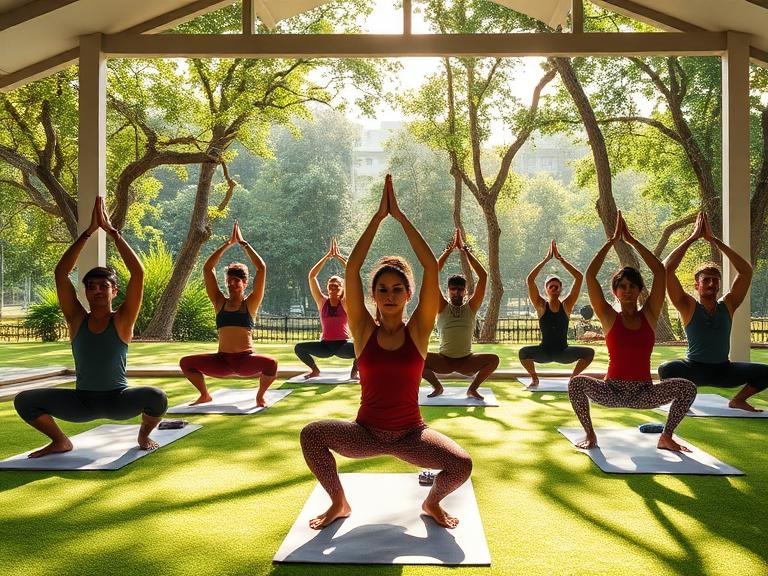
While a quick five-minute desk routine is a fantastic daily habit, practicing with an experienced instructor can help ensure your alignments are safe and effective. Chennai is home to several top-tier yoga centers that offer specialized corporate classes, alignment workshops, and accessible beginner programs.
1. 136.1 Yoga and Wellness Academy (Alwarpet)
Located in the quiet, tree-lined neighborhood of Alwarpet, 136.1 Yoga Academy is one of Chennai’s premier destinations for holistic health. The studio features large, sunlit rooms, natural wooden flooring, and a calm atmosphere that feels far removed from the busy city outside.
The academy is highly regarded for its structured approach to teaching proper body mechanics. Rather than focusing on fast, athletic routines, their instructors prioritize precise physical alignment and controlled breathing. They offer specialized evening restorative sessions that are perfect for corporate professionals looking to unwind and release upper body tension after a long workday.
- Key Features: Highly trained alignment teachers, dedicated restorative schedules, and a peaceful, premium practice space.
- Location: Eldams Road, Alwarpet, Chennai.
2. Krishnamacharya Yoga Mandiram – KYM (Mylapore)
Founded in 1976 by T.K.V. Desikachar, the Krishnamacharya Yoga Mandiram in Mylapore is a globally recognized institution for personalized yoga therapy. KYM specializes in customizing practices to meet the unique health needs, structural challenges, and fitness levels of each individual student.
For office workers dealing with chronic repetitive strain injuries, severe back issues, or high stress, KYM offers personalized one-on-one therapy sessions. Senior consultants design simple, custom routines that can easily be practiced at home or at an office desk, ensuring a safe recovery process for students of all ages.
- Key Features: Globally recognized yoga therapy, personalized individual routines, and deep expertise in anatomy and recovery.
- Location: Ramakrishna Nagar, Mylapore, Chennai.
3. Sivananda Yoga Vedanta Centre (Adyar)
Situated in the residential neighborhood of Adyar, the Sivananda Yoga Vedanta Centre provides a traditional, meditative environment for classical yoga practice. The center focuses on a balanced lifestyle based on proper exercise, deep breathing, and mindful relaxation.
Their introductory courses are excellent for office workers who want to learn how to manage stress through breathing and foundational postures. The slower, meditative pace of their classes helps calm an overstimulated nervous system, making it an ideal choice for professionals looking to balance out a high-pressure work life.
- Key Features: Focus on traditional breathing techniques, gentle beginner classes, and a strong emphasis on mental relaxation.
- Location: 3rd Avenue, Indira Nagar, Adyar, Chennai.
Structural Comparison: Comparing Workplace Wellness Methods
To help you choose the best way to manage your physical health during the workday, the following reference table breaks down the differences between common workplace wellness activities.
| Feature | 5-Minute Desk Yoga | Standard Gym Workouts | Casual Office Walking | Ergonomic Office Chairs |
| Time Required | 5 minutes. | 60 to 90 minutes. | 10 to 20 minutes. | Passive (all day). |
| Primary Physical Focus | Spinal alignment and releasing muscle tension. | Building muscle strength and cardiovascular endurance. | Increasing daily step counts and general circulation. | Providing passive support for the lower back. |
| Impact on the Nervous System | Calms the body (activates parasympathetic recovery). | Energizes the body (activates sympathetic drive). | Neutral or mildly relaxing. | Neutral; provides purely structural support. |
| Clothing Required | Standard professional office wear. | Athletic workout clothes. | Standard office clothing. | Standard office clothing. |
| Primary Financial Cost | Free. | Monthly gym membership fees. | Free. | Expensive upfront investment. |
FAQs
Do I need a yoga mat to practice these 5-minute desk stretches?
No, you do not need a yoga mat. All the movements in this routine are designed to be performed safely and comfortably using your standard office chair and desk.
Can a 5-minute desk yoga routine replace my regular gym workouts?
No, a five-minute routine is designed to break up long periods of sitting and reduce muscle stiffness during the workday. It should complement, rather than replace, your regular cardiovascular and strength training exercises.
Is it normal to feel a cracking sound in my spine during a seated twist?
Gentle popping or cracking sounds are common and usually represent the safe release of air bubbles from your joint capsules. However, if a movement causes sharp pain or tingling sensations, stop immediately.
How often should I practice this 5-minute desk yoga routine?
For the best results, try to practice this routine twice a day—once mid-morning to wake up your body, and once mid-afternoon to beat the post-lunch energy dip.
Can I practice these seated yoga poses in a standard rolling office chair?
Yes, you can use a rolling chair, but make sure to press it firmly against your desk or a wall so it stays stable and doesn’t roll away from you while you stretch.
Will doing desk yoga splits or intense stretches make me sweat at work?
No, this specific micro-routine focuses on gentle, controlled flexibility and breathing. It is designed to release muscle tension without increasing your heart rate to a point where you sweat.
Can desk yoga help reduce tension headaches caused by computer screen glare?
Yes, tension headaches are often caused by tight muscles at the base of the neck. Stretching these muscles out helps improve blood circulation to the head and can ease headache discomfort.
Is desk yoga safe for individuals recovering from a lower back injury?
Yes, these movements are gentle and low-impact, but you should always consult your physician or physical therapist before starting a new stretching routine after an injury.
Can I practice these breathing exercises discreetly without distracting my coworkers?
Yes, the breathing patterns are completely silent and internal. You can easily practice them at your desk without drawing any attention from your colleagues.
How soon will I start noticing improvements in my posture from desk yoga?
You will likely feel an immediate relief from muscle tightness right after your first 5-minute session. Long-term improvements in your natural posture usually develop after three to four weeks of daily practice.