

Table of Contents
The Definitive Guide to Elevator Repair Services Hyderabad
Vertical mobility is the invisible spine of Hyderabad’s rapidly expanding skyline. From the sprawling IT corridors of HITEC City, Gachibowli, and the Financial District to the densely populated multi-family residential units in Kukatpally, Miyapur, and Secunderabad, elevators are high-utilization structural assets.
When a lift malfunctions, it disrupts daily operations, impacts businesses, compromises accessibility for elderly residents, and presents serious liability risks under the Telangana Lifts, Escalators, and Passenger Conveyors Act.
Securing premium engineering support means looking beyond a quick, local fix. This guide breaks down mechanical execution, local regulatory compliance, pricing structures, and preventive diagnostics for elevator repair services hyderabad.
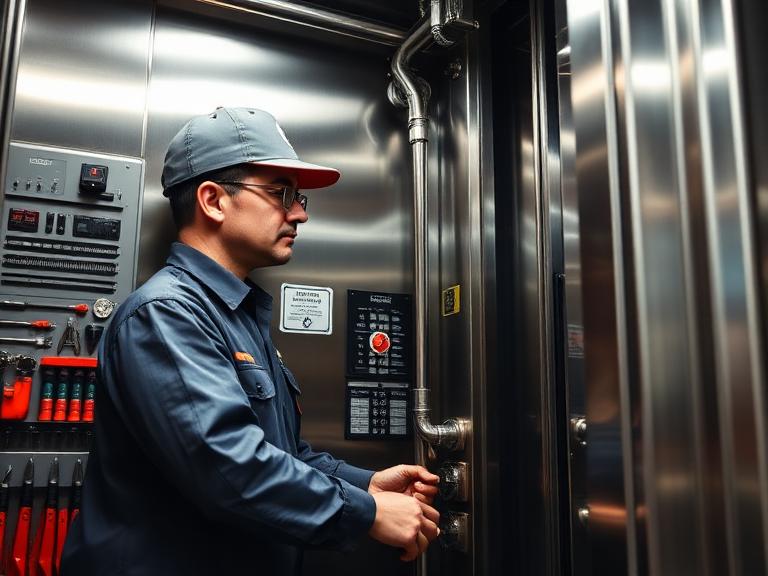
1. Core Engineering Profiles: Common Elevator Failures and Repair Protocols
Elevator systems are intricate networks combining structural metallurgy, high-voltage power distribution, microchip logic routing, and mechanical friction braking. Diagnosing these systems requires an understanding of exactly what goes wrong and how to fix it.
Electronic Drive and Inverter Faults (VVVF Drives)
The Variable Voltage Variable Frequency (VVVF) drive controls the acceleration, deceleration, and smooth leveling of modern gearless and geared traction elevators.
- The Failure: In Hyderabad’s peak summer months, extreme ambient temperatures inside concrete machine rooms or Machine-Room-Less (MRL) hoistways frequently cause thermal overload in the drive’s Insulated-Gate Bipolar Transistors (IGBTs). This shows up as sudden car jerking, leveling inaccuracies at landing doors, or “Drive Fault” lockouts on the main controller panel.
- The Repair Protocol: Technicians deploy calibrated digital multimeters and oscilloscopes to check DC bus voltage stability. Repair includes replacing degraded thermal paste, cleaning or replacing internal cooling fans, or re-calibrating the drive’s acceleration/deceleration S-curve parameters.
Automatic Rescue Device (ARD) & Battery Subsystem Failures
An ARD is a safety system that takes over during a power outage to safely bring the elevator car to the nearest landing floor and open the doors.
- The Failure: Seasonal power cuts or grid fluctuations can overwork ARD lead-acid or lithium-ion battery banks. Constant deep-discharging without proper thermal management causes premature sulfation or thermal swelling. This leaves the lift stranded between floors during an outage.
- The Repair Protocol: Field engineers conduct specialized load-testing on each battery cell to measure internal resistance. If a cell drops below 80% of its rated capacity ($12\text{V}/\text{7.2Ah}$ or $9\text{Ah}$ standards), the entire bank is replaced, and the charging voltage on the control panel is re-tuned to prevent overcharging.
Door Operator Mechanisms and Safety Light Curtains
Statistics show that nearly 70% of all elevator downtime stems from door operation snags.
- The Failure: Landing door tracks collect dirt, lint, and debris, which increases mechanical friction. At the same time, high passenger traffic can misalign infrared light curtains (3D multi-beam door sensors), causing doors to repeatedly cycle or lock open.
- The Repair Protocol: Repair teams clear the sills, replace worn-out eccentric door hangers, adjust the tension of the door operator synchronous belt, and recalibrate the infrared sensor array lines to ensure clear communication with the primary controller.
2. Structural Breakdown: Geared vs. Gearless MRL Systems
Understanding your specific elevator infrastructure helps clarify what your repair or maintenance service entails. The table below outlines how traditional geared systems compare with modern Machine-Room-Less (MRL) configurations.
| Technical Attribute | Geared Traction Lift Systems | Gearless Machine-Room-Less (MRL) |
| Mechanical Drive Unit | Worm-and-wheel gearbox coupled to a high-speed AC/DC motor. | Low-speed, high-torque permanent magnet synchronous motor (PMSM). |
| Lubrication Demand | High; requires regular gear oil changes and seal replacements. | Ultra-low; sealed bearings with no external gearbox oil requirements. |
| Energy Efficiency | Low to Moderate ($30\%\text{–}40\%$ energy loss through mechanical friction). | High ($50\%\text{ to }60\%$ more efficient via direct drive mechanics). |
| Common Repair Points | Gearbox oil leaks, thrust bearing wear, backlash adjustments. | Main bearing wear, encoder alignment, brake coil insulation failures. |
| Spatial Footprint | Requires a dedicated concrete room directly above the hoistway. | Fits entirely within the top of the existing shaft headroom. |
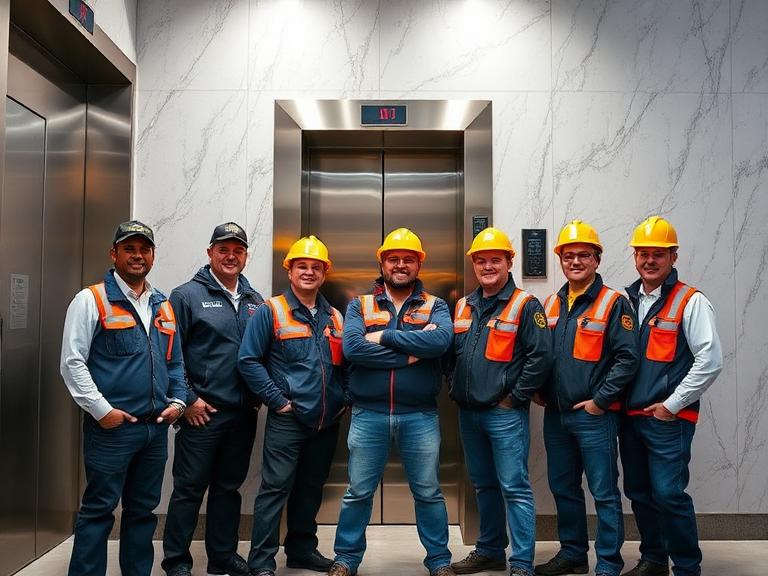
3. The 5-Phase Technical Troubleshooting and Repair Sequence
When an emergency call or breakdown request is logged in Hyderabad, professional elevator repair agencies follow a strict engineering sequence to safely resolve the issue.
1.Isolation and Lockout-Tagout (LOTO):Phase 1: Safety & Power Isolation.
Before any technician steps onto the car top or enters the pit, the primary 3-phase AC power breaker is shut off at the main distribution board. Padlocks and safety tags are affixed to prevent accidental re-energization while engineers work on mechanical elements or high-voltage circuits.
2.Diagnostic Log Extraction:Phase 2: Microcontroller Fault Code Analysis.
The technician powers up the diagnostic tool or reads the onboard LED matrix screen on the main controller board. Fault codes (such as E48 for safety loop open, E53 for drive communication failure) are cross-referenced with the manufacturer’s technical schematic to pin down the root cause.
3.Safety Circuit Loop Continuity Testing:Phase 3: Verify the Safety Chain.
A series safety circuit runs throughout the entire shaft, linking landing door interlocks, car gate switches, pit stop buttons, and overspeed governors. Using a digital multimeter, the technician checks continuity across these points to locate the exact switch causing the system shutdown.
4.Component Calibration or Replacement:Phase 4: Physical Part Rectification.
The faulty part (e.g., a pitted landing door contact switch, a broken limit switch, or a worn brake liner) is replaced with an OEM part. If it’s an electronic issue, the VVVF drive settings and leveling magnet positions are re-calibrated.
5.Dynamic Load and Safeties Verification:Phase 5: Live Operational Testing.
Power is safely restored. The elevator undergoes multiple test runs, moving through no-load, partial-load, and full-load cycles. Technicians closely monitor floor-leveling accuracy, smooth door operation, sound levels, and the response of the emergency brake before handing the system back to the building management.
4. Market Cost Analysis: 2026 Price Estimates in Hyderabad
Elevator repair costs vary based on building height, capacity, drive type, and the scale of the mechanical failure. The matrix below outlines current estimated costs for ad-hoc repairs and structured Annual Maintenance Contracts (AMC) across Telangana.
Ad-Hoc Repair & Component Replacement Price Matrix
Note: The prices listed below represent local market averages for components and single-visit engineering fees. They do not include structural or civil modification costs.
- Standard Emergency Single-Visit Diagnostic Fee: ₹1,500 – ₹3,500 (Covers initial troubleshooting, safety loop trace, and minor sensor tuning)
- Automatic Rescue Device (ARD) Battery Pack Replacement (Set of 3 or 4): ₹8,500 – ₹14,000
- Infrared Multi-Beam Safety Light Curtain Kit: ₹6,500 – ₹12,000
- VVVF Drive Repair / Component-Level Card Replacement: ₹12,000 – ₹28,000
- Traction Steel Wire Rope Replacement (Per Core Meter, 10mm–12mm): ₹450 – ₹850
- Main Drive Traction Motor Rewinding (10-Passenger Geared Motor): ₹25,000 – ₹45,000
Annual Maintenance Contract (AMC) Price Scale
To avoid high unexpected repair bills, most commercial spaces and gated communities set up formal service contracts:
5. Regulatory Compliance and Safety Mandates in Telangana
The Telangana High Court has consistently emphasized strict safety guidelines for lifts and elevators to address operational accidents in urban high-density areas. Property owners and developers must stay compliant with the current legal framework.
The Telangana Lifts Act Licensing Lifecycle
- Permission to Erect (Form-A): Before installing a new elevator or executing a major modernization overhaul, building blueprints, structural stability certificates, and electrical layouts must be submitted to the Chief Electrical Inspectorate.
- License to Run (Form-B): Once the repair or installation is complete, a Government Lift Inspector conducts field checks (including load tests, brake drop evaluations, and ARD simulation tests) to verify the system’s fitness before granting an operational license.
- Mandatory Renewal Cycles: Operational licenses are not permanent. They require periodic renewals backed by certified safety logs. Running a commercial or residential lift with an expired state license is a punishable offense that introduces severe liability risks for the property owner.
National Building Code (NBC 2016) & BIS Compliance
Every professional repair and replacement job must follow national engineering codes:
- IS 14665: The Indian Standard governing electric passenger lifts, detailing parameters for mechanical rope tension, car safety gears, and structural calculations.
- IS 15785: Specifically details safety standards for Machine-Room-Less (MRL) elevator layouts.
- Fire-Rated Landing Doors: Enclosures and landing doors must offer at least a 1-hour fire resistance rating. This prevents the vertical hoistway from acting as a chimney that spreads smoke and fire to intermediate floors during an emergency.
6. Proactive Diagnostics: Troubleshooting Before calling a Technician
Before scheduling a call for elevator repair services hyderabad, facility managers can run through a few basic checks to diagnose or even resolve minor system lockouts.
The Baseline Troubleshooting Checklist
- Check the Safety Stop Switches: Verify that the emergency stop buttons inside the cabin or inside the pit have not been accidentally pressed during cleaning or moving.
- Inspect the Landing Door Sills: Clean out stones, dust, or small debris lodged inside the bottom tracks of the sliding doors. Even a minor obstruction can stop the mechanical interlock from closing, which keeps the entire safety loop open.
- Verify Phase Sync on the Main Line: Elevators run on 3-phase power supply. If your neighborhood experiences a phase drop or voltage spike, the onboard phase failure relay will shut down the control panel to protect the traction motor. Check your main panel to ensure all three phases are stable.