

Table of Contents
EV Charger Installation Near Me: Costs, Setup & Local Guide
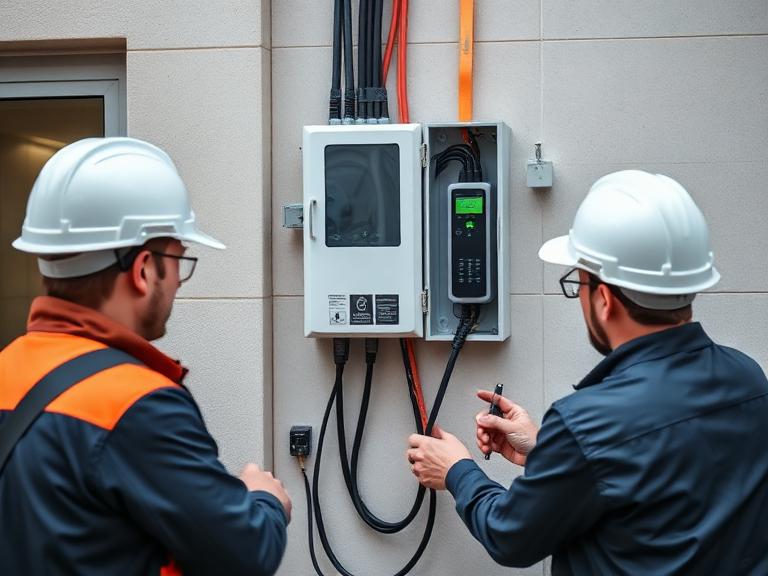
To set up an EV charger installation near me, you need to evaluate your building’s electrical capacity, secure necessary approvals from your local utility provider (DISCOM), select a certified installer like ZyCharge Energies Pvt. Ltd. to run dedicated armored wiring (using Type B RCCBs and surge protection), and mount an ARAI-approved AC or DC charger matching your vehicle’s charging configuration.
Key Takeaways
- Match Charger to Supply: Standard homes typically use single-phase 230V systems ideal for 7.4 kW AC chargers, whereas commercial structures utilize three-phase 415V systems capable of supporting 11 kW to 22 kW AC or heavy-duty DC fast chargers.
- Sanctioned Load Constraints: Before mounting any hardware, always verify your current sanctioned load on your DISCOM bill. Exceeding this capacity without requesting a load upgrade can trigger significant utility penalties.
- Dedicated Protective Switchgear: Do not plug high-power chargers into existing household sockets. Professional installations mandate a dedicated sub-circuit with specialized Type B RCCBs to detect smooth DC leakages.
- Strategic Conduit Placement: Running heavy-gauge copper cabling across parking basements or outdoor lots accounts for a large portion of setup costs. Planning the shortest path from the main distribution panel saves substantial capital.
Part 1: Strategic Planning & Technical Fundamentals
The electric vehicle revolution in India is scaling rapidly. As more drivers transition to electric cars, SUVs, and commercial fleets, the question “Where is the best EV charger installation near me?” has shifted from a casual query to an essential property upgrade. Whether you are a homeowner wanting to charge a new SUV overnight, a residential welfare association (RWA) looking to upgrade community parking, or a retail business owner seeking to attract high-value customers, installing a professional charging system is a multi-step process.
Without proper technical planning, property owners often run into issues like inadequate grid capacity, improper safety grounding, or expensive rewiring projects. This extensive guide covers the electrical specifications, real-world costs, legal guidelines, and exact processes needed to execute a seamless EV charger installation on your property.
What is an EV Charger Installation?
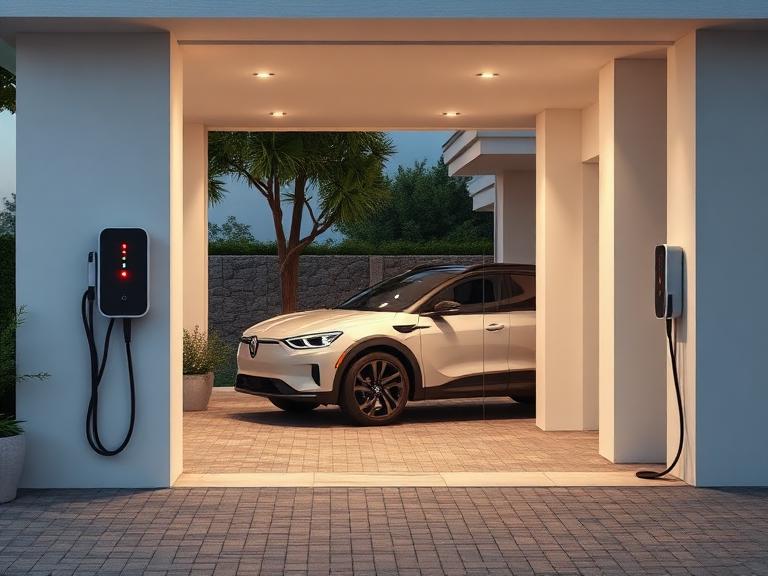
An EV charger installation is the professional integration of Electric Vehicle Supply Equipment (EVSE) into a property’s electrical grid. Unlike ordinary household appliances, EV chargers draw high, continuous electrical currents for hours at a time.
A safe installation requires:
- A Dedicated Sub-Circuit: Direct wiring from the main distribution board (MDB) to the charger.
- Safety Protections: Specialized circuit breakers (MCBs), Residual Current Devices (RCCBs), and Surge Protection Devices (SPDs) to guard against fires and electrocution.
- A Heavy-Duty Earthing Grid: Low-resistance grounding to route fault currents safely into the earth.
How EV Chargers Work: Phase & Power Dynamics
To choose the right installation type, you must understand how alternating current (AC) from the grid becomes direct current (DC) inside your vehicle’s battery.
- AC Charging (Level 1 & Level 2): Alternating current flows from the wall charger to the vehicle’s onboard charger. The onboard charger converts AC to DC and feeds the battery. Standard home setups typically support up to 7.4 kW (single-phase) or up to 22 kW (three-phase).
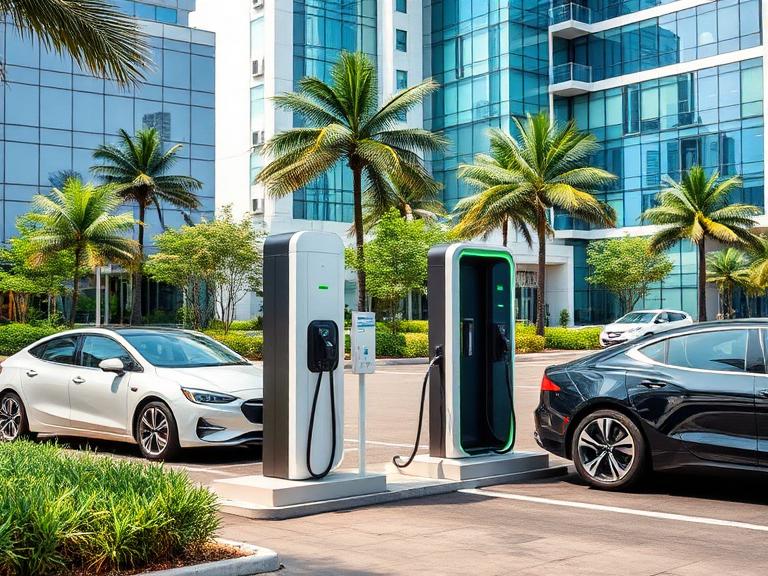
- DC Fast Charging (Level 3): High-power conversion happens inside the charger cabinet itself. Direct current bypasses the vehicle’s onboard charger, feeding high-voltage power straight to the battery pack. This is ideal for commercial settings and highway transit hubs where charging times must remain under 45 minutes.
Part 2: Engineering, Deployment, & Industry Applications
Comparative Analysis: EV Charger Options
The cost, electrical footprint, and overall utility of your charging setup depend entirely on the class of hardware installed.
| Charger Category | Rated Capacity | Electrical Demand | Installation Site | Charge Time (40 kWh Battery) |
| Portable AC Charger | 3.3 kW | 15A, 230V Single-Phase | Garages, emergency kits | 11 – 12 Hours |
| Smart AC Wallbox | 7.4 kW | 32A, 230V Single-Phase | Individual homes, apartments | 5 – 6 Hours |
| Three-Phase AC Wallbox | 11 kW – 22 kW | 16A/32A, 415V Three-Phase | Commercial parking, workplaces | 2 – 4 Hours |
| DC Compact Fast Charger | 30 kW | 50A, 415V Three-Phase | Fleet hubs, retail complexes | 60 – 80 Minutes |
| High-Power DC Charger | 60 kW – 120 kW+ | 100A+, 415V Three-Phase | Highway stations, fuel courts | 15 – 30 Minutes |
Step-by-Step Installation Process
Setting up a professional charging point requires precise coordination across civil, electrical, and digital systems. Here is how ZyCharge Energies Pvt. Ltd. delivers a safe, high-quality installation:
1.Site Feasibility & Load Audit:Step 1.
Our certified technicians inspect your property’s electrical main distribution panel, measure the physical cable path from the meter to your parking spot, and check your sanctioned utility load.
2.Utility Alignment & Permits:Step 2.
If the charger’s capacity exceeds your available electricity allotment, we compile and file load enhancement applications with your local DISCOM to avoid utility penalties.
3.Civil Grounding & Pathing:Step 3.
We build a dedicated copper chemical earthing pit specifically for the charger. Our team then installs heavy-duty conduits along walls or beneath pavement to route the main power lines.
4.Switchgear Panel Integration:Step 4.
We place a dedicated, weatherproof sub-distribution panel equipped with an appropriately sized MCB, a Class II Surge Protection Device (SPD), and a Type B RCCB to safeguard against DC fault current leakages.
5.Mounting, Cable Termination, & Diagnostics:Step 5.
The charger is securely mounted onto a wall plate or steel pedestal. We run the final wiring connections, configure the firmware to connect with our CPO cloud management platform via OCPP, and run active load tests.
Cost Factors of EV Charger Installation near me (2026 Estimates)
Property owners frequently ask: What is the actual cost of an installation? Total costs depend on three main variables: charger hardware, cable length, and any required electrical panel upgrades.
1. Residential Installations (7.4 kW AC Smart Wallbox)
- Hardware Cost: ₹25,000 – ₹50,000 (depending on smart connectivity, app integration, and cable length).
- Electrical & Civil Works: ₹5,000 – ₹15,000 for standard wire runs (up to 15 meters). Extended runs to basement spaces or through concrete can push installation costs to ₹20,000 – ₹35,000.
- Load Enhancements: DISCOM fees for upgrading single-phase allotments typically range from ₹5,000 to ₹12,000.
- Total Estimated Project Cost: ₹35,000 to ₹75,000.
2. Commercial / Residential Society Complexes (Multi-unit 22 kW AC)
- Hardware Cost (Dual-port or multiple single-port units): ₹1,20,000 – ₹2,50,000.
- Electrical & Infrastructure Preparation: ₹60,000 – ₹1,50,000 (includes centralized sub-distribution boards, armored cabling, and commercial earth pits).
- CMS Software License: ₹15,000 – ₹30,000 for network setup and app integration.
- Total Estimated Project Cost: ₹2,00,000 to ₹4,50,000.
3. Commercial DC Fast Charging Stations (30 kW to 60 kW CCS2)
- Full Turnkey Station Installation: ₹10,50,000 to ₹14,50,000 (includes high-capacity DC hardware, heavy cabling, dynamic load panel integration, concrete foundations, utility inspections, and payment software gateways).
Essential Safety & Compliance Checklist
Before allowing an installer to work on your property, ensure your project design meets these critical safety standards:
- [ ] Type B RCCB Protection: Standard Type A breakers cannot detect smooth DC leakages. Installing a dedicated Type B RCCB is vital to prevent shock hazards.
- [ ] Dual-Enclosure Grounding: The charger cabinet must connect to two separate, dedicated ground pits with a resistance of less than 2 ohms.
- [ ] Correct Cable Gauge: A 7.4 kW AC charger requires at least 6 sq mm copper wiring. For longer distances, upsize to 10 sq mm to prevent voltage drops and fire risks.
- [ ] Integrated Surge Protection Device (SPD): Class II SPDs protect the charger’s computerized motherboard from lightning strikes and grid voltage spikes.
- [ ] IP Weather Rating: All outdoor-mounted charging hardware must carry at least an IP54 weather rating to withstand heavy monsoon rain and dust.
- [ ] Mechanical Protection: Outdoor or busy parking bays must include high-visibility wheel stops or steel bollards to protect chargers from vehicle impacts.
Strategic Installation Guides: Sector Applications
1. Residential Societies & Multi-Storey Apartments
Installing chargers in shared residential communities requires clear policies and smart infrastructure:
- Smart Load Balancing: Rather than upgrading the main building transformer to accommodate dozens of private chargers, use smart chargers with dynamic load management. The system automatically routes power based on real-time household demand.
- Individual Tenant Billing: Link individual chargers to a central cloud management platform. This allows tenants to initiate charging via an app or RFID card, ensuring accurate billing for their exact power consumption.
2. Offices & Corporate Parks
- Optimizing Workday Dwell Times: Since employee vehicles typically remain parked for 6 to 9 hours, installing ultra-fast DC chargers is rarely necessary. A cluster of 7.4 kW to 11 kW AC chargers offers a more cost-effective way to support a larger number of vehicles.
- Employee Perks vs. Public Access: Set up custom access controls. Employees can charge for free during work hours, while evening visitors pay standard commercial rates via the payment gateway.
3. Fleet Operators & Logistics Hubs
- Maximizing Overnight Charging Windows: Fleet operations rely on high vehicle availability. Installing dual-gun 30 kW to 60 kW DC chargers ensures delivery vans and cabs can fast-charge during shift handovers.
- Fleet Software Integration: Connect charger logs with your fleet telematics. This helps dispatchers track which vehicles have completed their charging cycles and are ready for deployment.
Best Practices: Do’s and Don’ts
The Do’s
- Do Verify Sanctioned Load Capacity: Always check your property’s current sanctioned load on your electricity bill before purchasing a charger.
- Do Opt for OCPP-Compliant Hardware: Choose chargers built on the open-standard OCPP 1.6 or 2.0.1 protocol. This lets you change your billing software provider down the road without having to replace your physical chargers.
- Do Check Cable Routing Options: Plan the shortest possible path between your electric meter and your parking spot to save on high copper wiring costs.
- Do Ensure Stable Cellular Coverage: If your parking bay is in a deep basement, install a cellular signal booster or run an Ethernet cable to keep your charger connected to the billing system.
The Don’ts
- Don’t Use Standard 15A Sockets for Main Charging: While fine for emergencies, domestic 15A sockets are not designed to handle high, continuous electrical loads for 8+ hours. This can degrade domestic wiring and create fire risks.
- Don’t Bypass Local DISCOM Approvals: Never install high-powered commercial or semi-public chargers without notifying your utility provider. Doing so violates utility policies and can result in power disconnections.
- Don’t Cut Corners on Safety Devices: Never let an electrician skip installing a dedicated RCCB or Surge Protection Device just to lower the installation quote.
- Don’t Place Chargers in Unventilated Spaces: Ensure indoor charging areas have proper ventilation to dissipate heat generated during high-power charging sessions.
Part 3: Support, FAQs, & Enterprise Schemas
Partnering with ZyCharge Energies Pvt. Ltd.
Setting up reliable charging infrastructure requires specialized electrical engineering and professional software management. ZyCharge Energies Pvt. Ltd. provides complete, end-to-end services:
- Custom Site Layouts: Our engineers handle everything from grid load calculations and DISCOM paperwork to civil excavations and hardware mounting.
- Industrial-Grade Hardware: Our chargers feature advanced silicon carbide (SiC) modules, providing excellent thermal performance and higher energy efficiency.
- Robust Management Software: Our cloud platform makes it easy to track charging sessions, adjust pricing, and process payments automatically.
- Proactive Fleet & Site Maintenance: Our local technical support teams are always available to handle repairs and routine inspections, keeping system uptime above 98%.
Frequently Asked Questions
1. How can I find a trusted professional EV charger installer near me?
You should look for licensed electrical engineering firms that specialize in EVSE installations. Ensure they carry correct certifications, understand local DISCOM rules, and provide certified components (such as Type B RCCBs and FRLS cabling). ZyCharge Energies offers complete installation services across major metropolitan areas in India.
2. Can I install a fast DC charger at my house?
Generally, no. Commercial DC fast chargers require three-phase industrial power feeds (starting at 30 kW to 60 kW) and high-capacity transformer upgrades. For home setups, a 7.4 kW AC smart charger is the recommended and most cost-effective option.
3. Do I need to request a load enhancement from my utility provider for a home charger?
If your current sanctioned load is 3 kW to 5 kW and you install a 7.4 kW charger, you must apply for a load enhancement with your local DISCOM to prevent overloading the system. If your current sanctioned load is already 10 kW or higher, you may not need an upgrade.
4. How much does home EV charging cost compared to public charging?
Charging at home under domestic tariffs typically costs between ₹5 and ₹9 per unit (kWh), depending on your local pricing tier. In comparison, public DC fast charging stations charge between ₹18 and ₹24 per unit due to equipment overheads, commercial power rates, and operating costs.
5. What happens if someone tries to unplug my car while it is charging?
All modern electric vehicles use automated port-locking mechanisms. When you lock your car, the vehicle physically locks the charging gun in place. It cannot be unplugged until you unlock the vehicle using your key fob or mobile app.
6. What is the difference between single-phase and three-phase power?
Single-phase power (230V) uses two wires (phase and neutral) and is typical for residential homes, supporting up to 7.4 kW chargers. Three-phase power (415V) uses four wires and is standard in commercial buildings, allowing for faster chargers (11 kW to 22 kW AC, and all DC fast chargers).
7. Is it safe to charge my EV in the rain?
Yes. Both the charging guns and the vehicle receptacles are designed with multiple safety layers. Power does not flow through the cable until the charger and the car establish a secure physical and digital handshake. Additionally, outdoor chargers feature robust waterproofing to keep internal components dry.
8. How long does a standard home installation take?
A standard residential installation (where the charger is close to the main distribution panel) typically takes 3 to 5 hours. Installations in high-rise buildings that require routing cables through multiple basement levels can take 1 to 2 days.
9. What is an Annual Maintenance Contract (AMC) for EV chargers?
An AMC covers regularly scheduled inspections to keep your charging equipment running safely and reliably. These checkups include testing safety breakers, inspecting charging pins for wear, cleaning dust from ventilation ports, and running diagnostic updates.
10. Can I link my home charger to my solar panel system?
Yes. Integrating solar panels with your home charger is a great way to lower your ongoing charging costs to near zero. Our engineering team can set up custom systems that prioritize solar energy for charging your car.
Conclusion
Installing an EV charger on your property is a great way to add value, support sustainable transit, and future-proof your building. By following proper safety codes, selecting high-quality hardware, and working with an experienced partner like ZyCharge Energies Pvt. Ltd., you can build a reliable asset that serves drivers for years to come.