

Table of Contents
EV Charging Equipment Hyderabad | Complete Guide
The growth of electric vehicles is increasing the demand for reliable and appropriately selected charging infrastructure. For homeowners, apartment communities, offices, commercial properties, fleet operators, and public charging businesses, choosing the right EV charging equipment in Hyderabad is an important part of developing a dependable charging setup.
EV charging equipment is not limited to the charger itself. A complete charging installation may include charging units, connectors, cables, electrical protection devices, distribution equipment, communication systems, networking components, monitoring software, mounting structures, and other site-specific infrastructure.
The right equipment depends on several factors, including the type of electric vehicle, required charging speed, available electrical capacity, location, expected usage, operating environment, and future expansion plans.
Hyderabad’s growing commercial activity, residential development, technology sector, and increasing EV adoption create different charging requirements across the city. A residential community may need multiple AC charging points, while a fleet depot or public charging location may require higher-powered DC fast chargers.
This guide explains the major types of EV charging equipment, their applications, selection factors, installation requirements, maintenance considerations, and important questions to ask before setting up an EV charging facility.
What Is EV Charging Equipment?
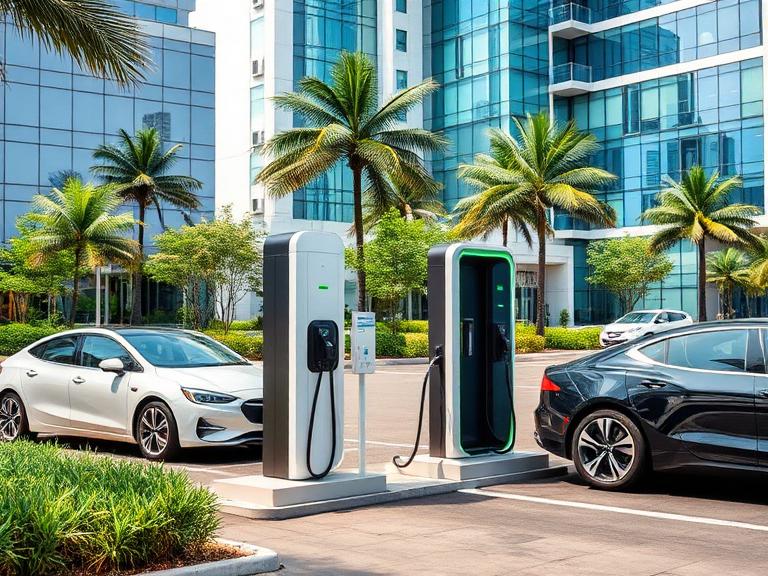
EV charging equipment refers to the hardware and supporting infrastructure used to safely transfer electrical energy to an electric vehicle.
A typical EV charging system may include:
- AC EV chargers
- DC fast chargers
- Charging cables
- Charging connectors
- Charging guns
- Electrical distribution equipment
- Circuit protection devices
- Energy meters
- Communication systems
- RFID readers
- Payment systems
- Networking equipment
- Charging management software
- Mounting structures
- Safety equipment
The exact combination depends on whether the installation is intended for residential, commercial, fleet, workplace, apartment, highway, or public charging use.
Why Is the Right EV Charging Equipment Important in Hyderabad?
Selecting charging equipment based only on charging speed can lead to problems later.
A proper charging solution should consider the entire site rather than just the charger rating.
Important considerations include:
Electrical capacity
The available electrical connection must be able to support the intended charging load.
Vehicle compatibility
Different EVs support different charging standards, connector types, and power levels.
Charging requirements
A home user may not need the same charging speed as a commercial fleet operator.
Usage frequency
A charger used occasionally has different operational requirements from equipment operating throughout the day.
Location
Outdoor charging stations require equipment suitable for the environmental conditions at the installation site.
Future expansion
Businesses and apartment communities may need additional charging points as EV adoption increases.
Types of EV Charging Equipment
There are several categories of charging equipment available for different applications.
1. AC EV Chargers
AC chargers are commonly used for residential, workplace, apartment, hotel, and other locations where vehicles can remain parked for longer periods.
The vehicle’s onboard charging system converts AC electricity into the DC power required by the battery.
AC chargers can be suitable for:
- Homes
- Apartments
- Offices
- Hotels
- Residential communities
- Workplaces
- Commercial parking areas
The appropriate power rating should be selected based on the vehicle, electrical infrastructure, and intended application.
2. DC Fast Chargers
DC fast chargers deliver direct current to the vehicle’s battery system, allowing higher charging power than typical AC charging.
They are commonly considered for:
- Public charging stations
- Highway charging
- Fleet depots
- Commercial facilities
- High-traffic locations
- Long-distance travel corridors
DC fast charging equipment is generally more complex and can require substantial electrical capacity and thermal management.
A proper site assessment is important before installing high-power DC equipment.
3. EV Charging Cables and Connectors
Charging cables and connectors are essential parts of the charging system.
Different vehicles and chargers may use different connector standards.
The correct connector depends on:
- Vehicle model
- Charging method
- Charger type
- Regional standards
- Manufacturer specifications
Charging cables should be selected for the intended current and power requirements.
Regular inspection is also important because cables and connectors experience repeated handling and mechanical stress.
4. Smart EV Charging Equipment
Smart EV chargers add communication and monitoring capabilities to conventional charging equipment.
Depending on the system, smart charging may provide:
- Remote monitoring
- Charging schedules
- User authentication
- Energy monitoring
- Load management
- Mobile application integration
- Usage reports
- Remote diagnostics
- Charging session management
Smart charging can be particularly useful for apartment communities, workplaces, fleet operators, and commercial charging networks.
5. EV Charging Management Systems
For installations containing multiple chargers, charging management software can become an important part of the infrastructure.
A charging management system can help operators monitor:
- Charger availability
- Charging sessions
- Energy consumption
- Equipment status
- User access
- Fault notifications
- Usage patterns
- Network connectivity
For commercial and public charging infrastructure, centralized monitoring can make equipment management more efficient.
6. Electrical Distribution Equipment
The charger is only one component of an EV charging installation.
Electrical infrastructure may include:
- Distribution boards
- Circuit breakers
- Protection devices
- Cabling
- Isolators
- Metering equipment
- Earthing systems
- Surge protection
- Load-management equipment
The exact requirements depend on the installation design and electrical characteristics of the site.
Electrical work should be planned and completed by appropriately qualified professionals.
EV Charging Equipment for Different Applications
Home Charging
Residential EV charging generally focuses on convenient overnight or scheduled charging.
AC charging equipment can be suitable where the vehicle remains parked for several hours.
The installation should consider:
- Parking location
- Electrical connection
- Cable routing
- Charger position
- Protection equipment
- Vehicle requirements
- Future charging needs
Apartment Charging
Apartment communities present different challenges because multiple residents may require charging access.
A scalable solution may involve:
- Multiple AC charging points
- Load management
- User authentication
- Energy metering
- Charging management software
- Dedicated parking allocations
- Centralized monitoring
Apartment charging infrastructure should be designed around both current and expected future EV adoption.
Office and Workplace Charging
Workplace charging allows employees or company vehicles to charge while parked during working hours.
Depending on the parking duration and electrical infrastructure, businesses may use AC chargers, smart chargers, or a combination of equipment.
Charging management systems can help businesses monitor usage and manage access.
Commercial Properties
Shopping centres, hotels, restaurants, hospitals, and other commercial properties may use EV charging as part of their parking and mobility infrastructure.
The appropriate equipment depends on:
- Customer parking duration
- Expected charging demand
- Available power
- Number of charging points
- Operating hours
- Payment requirements
A commercial site may combine AC charging for longer stays with DC fast charging where faster turnover is required.
Fleet Charging
Fleet operators have more structured charging requirements.
Electric buses, delivery vehicles, company cars, taxis, logistics vehicles, and other fleets may require charging according to operational schedules.
Fleet charging equipment should consider:
- Number of vehicles
- Daily travel distance
- Vehicle battery capacity
- Available charging time
- Depot power capacity
- Number of chargers
- Charging schedules
- Future fleet growth
Smart load management can help distribute available electrical capacity across multiple charging points.
How to Choose EV Charging Equipment in Hyderabad
Choosing charging equipment should start with an assessment of the intended application.
1. Determine the Vehicle Types
Identify the EV models that will use the charging infrastructure.
Different vehicles may have different charging capabilities and connector requirements.
2. Determine the Required Charging Speed
Ask whether the vehicles will be parked for several hours or need rapid charging.
Long parking durations may suit AC charging, while high-turnover applications may require DC fast charging.
3. Assess Electrical Capacity
Before selecting equipment, assess the site’s available electrical capacity.
This is particularly important when installing multiple high-power chargers.
4. Consider the Number of Chargers
A single charger has different infrastructure requirements from a charging facility with multiple charging points.
5. Consider Smart Features
For commercial and multi-user installations, features such as authentication, remote monitoring, load management, and energy reporting may be valuable.
6. Plan for Future Expansion
A scalable design can help avoid major infrastructure changes when charging demand increases.
EV Charger Installation Requirements
Installing EV charging equipment involves more than mounting a charger on a wall or parking structure.
A professional installation assessment may examine:
Electrical supply
The available electrical connection should support the planned charging load.
Cable routing
Cables should be routed safely and protected from mechanical damage.
Earthing and protection
Appropriate electrical protection and earthing arrangements are important parts of charging infrastructure.
Charger placement
The charger should be positioned for practical vehicle access while maintaining appropriate clearance and safety.
Environmental conditions
Outdoor installations should use equipment appropriate for the site’s environmental conditions.
Network connectivity
Smart chargers may require reliable network connectivity for monitoring and management.
Safety Considerations for EV Charging Equipment
Safety should be considered throughout the design, installation, operation, and maintenance of an EV charging system.
Important considerations include:
- Appropriate electrical protection
- Proper earthing
- Suitable cable sizing
- Correct equipment installation
- Connector inspection
- Protection against physical damage
- Appropriate environmental ratings
- Regular maintenance
- Manufacturer-compliant operation
Users should not attempt internal electrical repairs themselves.
If a charger shows signs of burning, overheating, exposed wiring, physical damage, repeated electrical faults, or abnormal operation, it should be taken out of service and assessed by a qualified professional.
EV Charging Equipment Maintenance
Regular maintenance helps identify problems before they result in prolonged downtime.
Maintenance activities may include:
- Visual inspection
- Cable inspection
- Connector inspection
- Electrical testing
- Protection-system checks
- Cleaning
- Temperature checks
- Communication testing
- Software and firmware review
- Error-log analysis
- Cooling-system inspection
- Performance testing
Maintenance frequency depends on charger type, manufacturer recommendations, operating environment, and usage.
High-use commercial and public charging stations may require more frequent inspection than residential equipment.
Common Problems With EV Charging Equipment
Even properly installed equipment can experience problems over time.
Common issues include:
Charger not powering on
Potential causes include power interruptions, electrical protection activation, or equipment faults.
Vehicle not charging
The issue could involve the connector, vehicle, authentication system, communication system, or charger.
Slow charging
Charging speed may be affected by vehicle limits, charger capacity, battery conditions, electrical supply, or configuration.
Overheating
High ambient temperatures, heavy use, connector problems, cooling-system faults, or other equipment issues can contribute to overheating.
Network problems
Smart charging systems may experience connectivity or backend communication issues.
Error codes
Diagnostic codes can indicate electrical, communication, thermal, software, or hardware problems.
Recurring faults should be professionally diagnosed rather than repeatedly reset.
Cost Factors for EV Charging Equipment in Hyderabad
The cost of an EV charging installation can vary considerably.
Important factors include:
- Charger type
- Power rating
- Number of charging points
- Electrical infrastructure
- Cable length
- Distribution equipment
- Protection systems
- Civil work
- Installation complexity
- Networking requirements
- Smart charging features
- Software requirements
- Maintenance arrangements
AC charging equipment typically has different infrastructure requirements from high-power DC fast charging.
For an accurate project estimate, the site and intended charging application should be assessed before equipment is selected.
Why Professional EV Charging Equipment Installation Matters
Professional installation can help ensure that the charging equipment is appropriately matched to the site’s electrical infrastructure and intended use.
A qualified installation team can help with:
- Site assessment
- Equipment selection
- Electrical planning
- Charger installation
- Cable routing
- Protection systems
- Commissioning
- Testing
- Network configuration
- Maintenance planning
This is especially important for commercial and high-power charging installations.
EV Charging Equipment for Future-Ready Infrastructure
EV charging infrastructure is evolving as electric vehicle adoption grows.
Future-oriented charging systems are increasingly focused on:
- Smart energy management
- Remote monitoring
- Dynamic load management
- Networked charging
- Data analytics
- Fleet management
- Renewable energy integration
- Energy storage integration
- Scalable charging infrastructure
Businesses and property owners planning new installations can consider equipment that supports expansion and intelligent energy management.
Why Choose ZyCharge for EV Charging Equipment?
ZyCharge Energies Pvt. Ltd. provides EV charging infrastructure solutions designed for different applications across India.
Its service areas include:
- AC EV chargers
- DC fast chargers
- EV charging station setup
- EV charger installation
- EV charger maintenance
- Charge Point Operator services
- Customized EV infrastructure
- Commercial charging solutions
- Fleet charging solutions
- Residential community charging
For projects in Hyderabad, the appropriate equipment can be determined based on the site, vehicle requirements, charging demand, electrical infrastructure, and intended operating model.
Frequently Asked Questions About EV Charging Equipment Hyderabad
1. What is EV charging equipment?
EV charging equipment includes chargers, cables, connectors, electrical protection devices, communication systems, meters, management software, and other infrastructure used to charge electric vehicles.
2. What types of EV charging equipment are available in Hyderabad?
Common options include AC EV chargers, DC fast chargers, smart chargers, charging cables, connectors, charging management systems, and supporting electrical infrastructure.
3. Which EV charger is suitable for home use?
AC chargers are commonly considered for home charging because vehicles can typically remain parked for several hours. The appropriate charger should be selected based on the vehicle and property’s electrical capacity.
4. What is the difference between AC and DC EV chargers?
AC chargers supply alternating current to the vehicle, where the vehicle’s onboard charger converts it for battery charging. DC fast chargers supply DC power directly to the vehicle’s battery system and can support higher charging power.
5. How much does EV charging equipment cost in Hyderabad?
Costs vary according to charger type, power rating, installation requirements, electrical infrastructure, number of chargers, smart features, and site conditions. A site assessment is generally required for an accurate estimate.
6. Can EV charging equipment be installed in apartments?
Yes. Apartment communities can install EV charging infrastructure, but the design should consider electrical capacity, parking arrangements, user access, metering, load management, and future demand.
7. What EV charging equipment is suitable for businesses?
Businesses may use AC chargers, DC fast chargers, smart chargers, or a combination depending on vehicle parking duration, charging demand, available electrical capacity, and operational requirements.
8. Is DC fast charging suitable for fleets?
DC fast charging can be suitable for fleets that require faster charging and have limited charging windows. The appropriate system depends on vehicle specifications and fleet operating schedules.
9. What electrical infrastructure is needed for EV chargers?
Requirements may include suitable electrical supply, distribution equipment, circuit protection, cabling, earthing, isolation, metering, and other site-specific components.
10. Do EV chargers require regular maintenance?
Yes. Regular inspection and maintenance can help identify cable, connector, electrical, communication, software, and cooling-related issues before they cause extended downtime.
11. What is a smart EV charger?
A smart EV charger can provide connected features such as remote monitoring, scheduling, energy management, user authentication, charging reports, and load management.
12. Can multiple EV chargers be installed at one location?
Yes. Multiple chargers can be installed at homes, apartments, offices, commercial properties, fleet depots, and public charging sites. Electrical capacity and load management should be considered during planning.
13. Can EV charging equipment be installed outdoors?
Yes, where the selected equipment is designed and rated for the intended outdoor environment. Installation should also consider weather exposure, physical protection, drainage, and electrical safety.
14. What should I consider when buying EV charging equipment?
Consider vehicle compatibility, charging speed, charger type, power capacity, connector requirements, electrical infrastructure, smart features, installation requirements, maintenance, warranty, and future expansion.
15. Can EV charging equipment be used for different EV brands?
Compatibility depends on the charger, connector, communication standards, and vehicle specifications. Equipment should be selected based on the vehicles expected to use the charging station.
16. How long does EV charging equipment last?
Service life varies according to equipment quality, usage, environment, maintenance, and manufacturer specifications. Regular maintenance can help identify components that need attention.
17. What causes an EV charger to stop working?
Potential causes include electrical faults, connector problems, overheating, communication failures, network issues, software problems, or internal component faults.
18. Is professional EV charger installation necessary?
Professional installation is strongly recommended because EV charging equipment must be appropriately integrated with the site’s electrical infrastructure and safety systems.
19. Can EV charging equipment be expanded later?
Many charging installations can be designed for future expansion. Planning electrical capacity, cable routes, distribution equipment, and space in advance can make future additions easier.
20. Does ZyCharge provide EV charging equipment solutions in Hyderabad?
ZyCharge Energies Pvt. Ltd. provides EV charging infrastructure solutions including AC chargers, DC fast chargers, installation, maintenance, charging station setup, and customized charging infrastructure for different applications.
Conclusion
Selecting the right EV charging equipment in Hyderabad requires more than choosing a charger based on its power rating. The equipment should match the vehicle requirements, electrical infrastructure, charging patterns, location, number of users, and future expansion plans.
AC chargers can be suitable for homes, apartments, workplaces, and locations where vehicles remain parked for longer periods. DC fast chargers may be appropriate for public charging, fleet operations, highways, and other applications where faster charging is important.
A complete charging solution may also require electrical protection, cables, connectors, energy management, communication systems, monitoring software, and regular maintenance.
For businesses, residential communities, fleet operators, and other organizations planning EV charging infrastructure in Hyderabad, a site-specific assessment can help determine the appropriate equipment and installation approach.